Move the Equilibrium, Not the Frequency: Target-Adjusted MPC for Microgrids
TL;DR — When demand and generation fall out of balance, a microgrid’s frequency moves away from nominal. Target-adjusted Model Predictive Control (MPC) does not move the desired frequency. It estimates the unseen power imbalance, calculates the state and control inputs that would balance it, and regulates the system around that updated equilibrium. Our simulations showed that this is a viable alternative to classical MPC—not a universally better one.
A frequency error is evidence
Imagine an islanded microgrid: a small electrical network operating without the stabilising support of a continental grid. Its generators and flexible resources must continuously match the power drawn by its loads.
When generation and demand differ, even briefly, the imbalance appears as a deviation from nominal grid frequency. In a low-inertia microgrid this deviation can develop quickly. The controller sees the frequency response, but it does not directly know the complete cause: an unmeasured load change, a generator shortfall, model error, or some combination of them.
The control problem is therefore more subtle than “bring frequency back to zero.” The controller must infer the missing power, decide how several actuators should share the correction, respect their capacity and ramp-rate limits, and do all of this fast enough to stabilise the grid.
Our question was:
Can MPC regulate microgrid frequency by explicitly estimating the disturbance and moving its internal operating equilibrium?
What classical MPC optimises
MPC repeatedly solves a finite-horizon optimisation problem. At each sampling instant it:
- estimates the current state;
- predicts how the system will respond to candidate control sequences;
- selects a sequence that balances frequency regulation, actuator movement, and reference tracking while satisfying constraints; and
- applies only the first action before measuring the system again.
This receding-horizon structure is attractive for microgrids because generators, storage, and tie-lines have different dynamics and physical limits.
A classical offset-free MPC can include an estimated disturbance in its predictions. Its objective, however, is expressed in the original state and input coordinates. The alternative explored in our paper changes those coordinates: it first asks where the system’s equilibrium has moved.
Move the equilibrium, not the nominal frequency
Suppose an observer estimates a persistent lumped disturbance . This term represents whatever unexplained input is needed to reconcile the model with the measured frequency. It can include an unmeasured load change as well as model–plant mismatch.
For that disturbance estimate, the controller calculates a corresponding equilibrium:
Here, is the state target and the control-input target. maps an estimated disturbance to a steady operating point that balances it.
The crucial distinction is:
- the desired frequency remains nominal;
- the estimated inputs required to maintain it change with operating conditions.
The target-adjusted MPC then penalises predicted deviations from and , rather than treating the original coordinate origin as the operating point. In plain language: estimate the missing power, work out what balanced operation now looks like, and control relative to that balance.
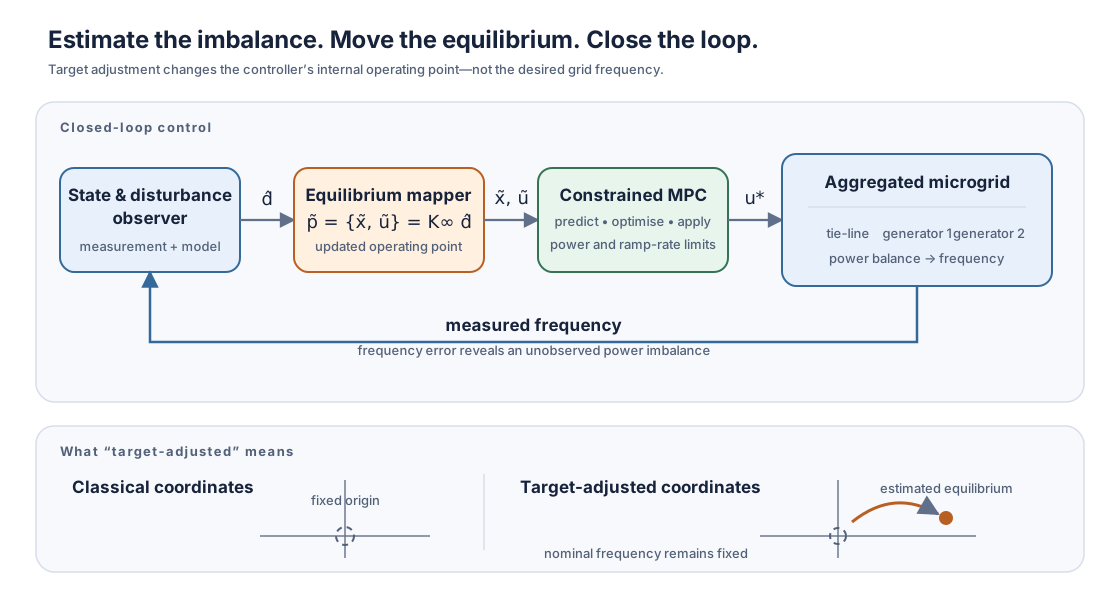
The target-adjusted control loop. Frequency measurements update a state and disturbance observer; the disturbance estimate moves the controller’s internal equilibrium, and constrained MPC allocates the corrective action across the available units. The nominal-frequency objective itself does not move.
Inside the loop
The architecture has three important components.
1. State and disturbance observer
A Kalman-filter-based observer combines the model with measured frequency. It estimates both the system state and a lumped disturbance . Observer tuning matters: a sluggish estimate delays the correction, while a poorly damped estimate can make the controller too aggressive.
2. Equilibrium calculation
The disturbance estimate is mapped to , the approximate state and actuator values at which the new power balance can be maintained. This is the “target adjustment” in the paper.
3. Constrained optimisation
The MPC decides how the controllable units should move. It can enforce:
- minimum and maximum power limits;
- ramp-rate limits;
- different penalties on actuator movement;
- unit-level input references supplied by another layer of a control hierarchy.
These weights do more than smooth a graph. They determine which unit responds most strongly and how frequency regulation is traded against actuator wear or adherence to dispatch requests.
What we tested
The study used a linear, aggregated test system containing:
- a swing-equation model of grid-frequency dynamics;
- tie-line dynamics;
- two generators with turbine and governor dynamics; and
- a two-second controller sampling interval.
The target-adjusted controller, denoted , was compared with a classical MPC formulation, . The online optimisation problems were solved with Gurobi. A time-varying load disturbance based on open power-system data excited the system; importantly, the reported simulations did not use disturbance forecasts.
The experiments examined three questions.
Can it reject a disturbance under constraints?
Yes. The target-adjusted MPC stabilised frequency while respecting hard power and ramp-rate bounds. By assigning a lower movement penalty to one generator, the controller deliberately made that unit carry more of the response. Its input saturated at points, demonstrating that the constraints were active rather than decorative.
Can it follow unit-level dispatch references?
Yes, with a trade-off. The controller tracked individual input references with a precision set by the corresponding weight. When those references collectively conflicted with the actual load, stronger reference tracking degraded frequency regulation. That is the expected engineering compromise: a controller cannot simultaneously honour an inconsistent dispatch plan and perfectly balance the grid.
Is it more robust than classical MPC?
Not in general. The two formulations responded differently when model parameters were deliberately mismatched. Target-adjusted MPC was faster in some cases, slower or more damped in others, and oscillated under one sufficiently large mismatch. All the tested control laws remained asymptotically stable in frequency, but the trajectories were intended for qualitative—not definitive numerical—comparison because the formulations have different tuning sensitivities.
An alternative, not a universal upgrade
The most important result is also the easiest to overstate: the paper did not find that target-adjusted MPC consistently outperformed classical MPC.
Classical MPC can place an entire predicted disturbance sequence directly in its objective. The target-adjusted formulation described here only gains predictive capability through an expected future disturbance state. When a good trajectory forecast is available, that difference can favour the classical formulation.
The contribution was instead to derive and demonstrate another valid way to formulate load-frequency control:
- it makes the estimated operating equilibrium explicit;
- it stabilised the simulated three-actor system;
- it handled input and ramp-rate constraints;
- it allocated control effort through interpretable weights; and
- it tracked actuator references suitable for coordination with a higher control layer.
That makes it useful both as a controller and as a comparison point for understanding how objective formulation, observer design, and disturbance modelling shape closed-loop behaviour.
Limitations and lessons
- Simulation, not field validation. Communication latency, measurement faults, nonlinear equipment behaviour, and implementation timing require further testing.
- The observer is part of the controller. Performance depends on how quickly and accurately the lumped disturbance is estimated.
- The equilibrium map depends on the model. Mismatch in the assumed disturbance dynamics can change damping, speed, and overshoot.
- The comparison is tuning-sensitive. The two MPC objectives do not respond identically to the same control-effort weights, so a plotted trajectory is not a universal ranking.
- Prediction is deliberately limited in the proposed form. Classical MPC can exploit a full disturbance forecast more directly.
- The model is aggregated and linearised. This keeps online optimisation manageable, but omits detail present in a physical microgrid.
For me, the lasting lesson was broader than this particular controller. A measured error is not merely something to suppress; it also contains information about the operating condition that produced it. The loop becomes more capable when it turns that information into an updated internal model before deciding what to do next:
That pattern—estimating hidden conditions and adapting the decision problem online—continues in my later work on uncertainty-aware modelling and adaptive sensing.
For further reading
- Original paper: Banis et al., “Load Frequency Control in Microgrids using target adjusted Model Predictive Control,” IET Renewable Power Generation, 2019. DOI: 10.1049/iet-rpg.2019.0487
- Related project: Target-Adjusted MPC for Microgrid Frequency Control
- Publication record: Load Frequency Control in Microgrids using Target-Adjusted MPC
- Research trajectory: From Energy Grids to Adaptive Biomedical Sensing