Target-Adjusted MPC for Microgrid Frequency Control
Research Question
How can a microgrid frequency controller update its operating target when an unmeasured change in net load shifts the equilibrium of the system?
Method
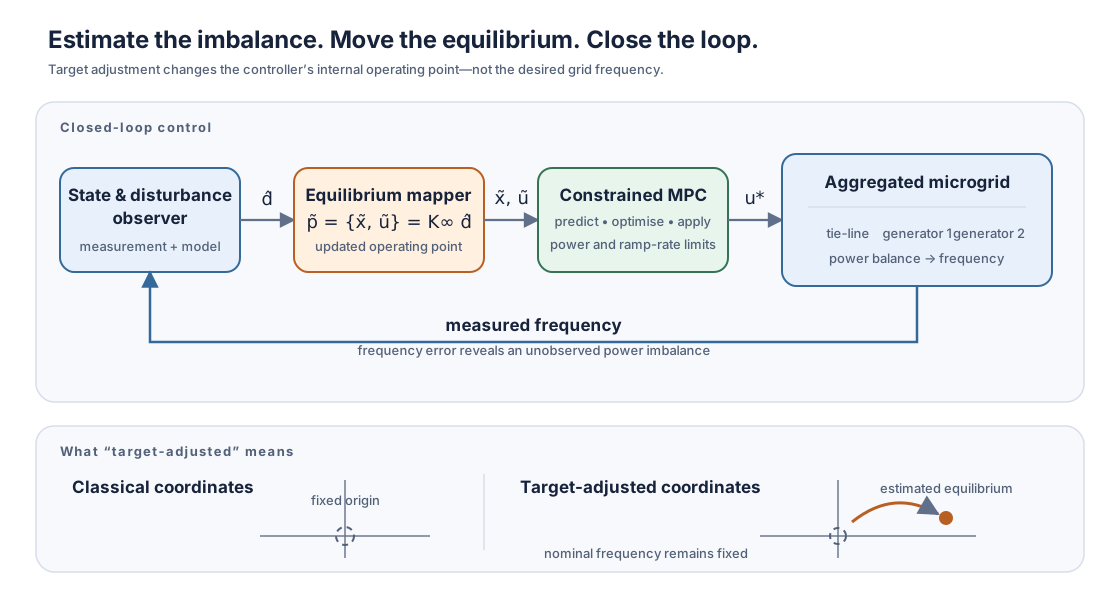
Target-adjusted MPC loop: measured frequency is used to estimate the lumped disturbance, update the equilibrium target, and compute the next constrained control action.
This project developed a target-adjusted Model Predictive Control (MPC) framework for microgrid frequency regulation. The approach combines:
- Receding-horizon optimization — solving a constrained optimal control problem at each time step over a prediction window.
- Disturbance estimation — inferring a lumped, approximately constant disturbance from the measured system response.
- Equilibrium target calculation — mapping that estimate to feasible steady-state targets for the system state and manipulated inputs.
The paper evaluates the controller in simulation on a linear three-area frequency-control model comprising a tie-line and two generating units. The reported study does not use disturbance forecasts or stochastic uncertainty ranges in the MPC objective.
Personal Contribution
Frederik Banis was the first author of the primary journal publication. He developed the target-adjusted MPC formulation, designed the simulation experiments, and wrote the manuscript. Co-authors contributed supervision, methodological guidance, and review.
Validation and Key Results
- Both classical MPC and target-adjusted MPC regulated the simulated frequency following changes in the aggregate load disturbance.
- Target adjustment changed the steady-state state and input references using an online disturbance estimate.
- In the reported experiments, the adjusted formulation did not show an advantage over classical MPC. The result is therefore methodological rather than evidence of universally improved regulation.
The method was published in IET Renewable Power Generation (2019), a peer-reviewed journal. As of March 2026, the paper has been cited 20 times (Google Scholar).
Outputs
- Journal paper: DOI 10.1049/iet-rpg.2019.0487
- Conference paper: MEDPOWER 2018 — Utilizing flexibility in Microgrids using MPC.
- Related software: SINDYc and MCMC Framework (Zenodo)
- PhD thesis: Efficient Operation of Energy Grids, DTU, 2020. DOI 10.11581/DTU.00000334
Collaborators
- DTU Compute, Technical University of Denmark — Henrik Madsen, Niels Kjølstad Poulsen (supervisors)
- Daniela Guericke (co-author)
Status and Next Steps
Status: Published (2019). The methodological foundation has been extended in subsequent work on hierarchical microgrid control and SINDYc-based prosumer modeling.
Transfer to current research: The sequential-decision framework developed here — repeated constrained optimization with online state and disturbance updates — is part of the methodological base that now drives adaptive waveform design for biomedical sensing.
Related Outputs
- Banis et al., "Load Frequency Control in Microgrids using target adjusted Model Predictive Control," IET Renewable Power Generation, 2019. DOI: 10.1049/iet-rpg.2019.0487
- Banis et al., "Utilizing flexibility in Microgrids using MPC," MEDPOWER 2018.
- SINDYc and MCMC Framework — Zenodo: 10.5281/zenodo.3911952